
Table of Contents
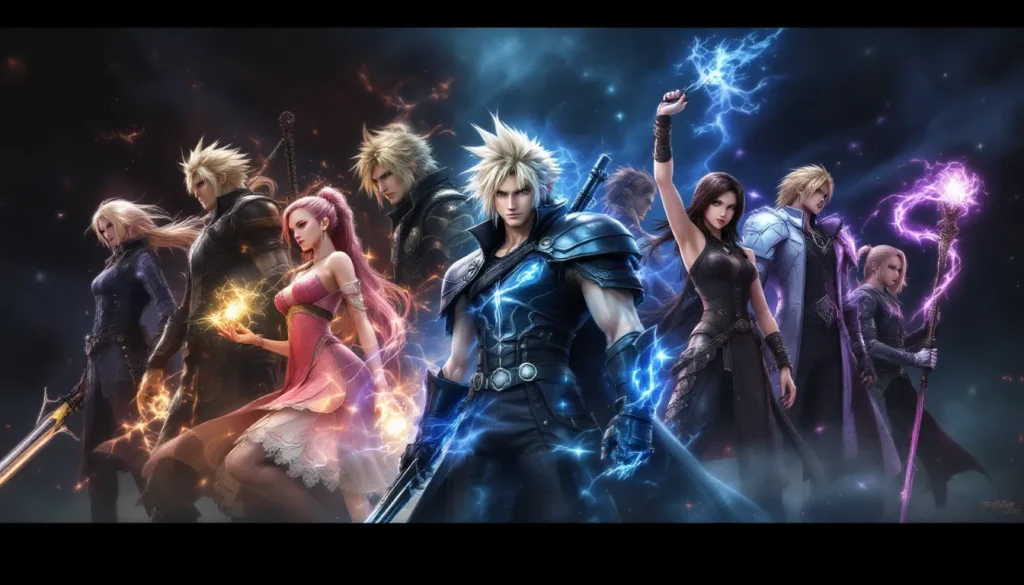
ToggleThe Final Fantasy franchise has given us some of gaming’s most unforgettable characters over three decades. From spiky-haired protagonists to world-ending villains, these characters have defined entire generations of gaming. They’re not just avatars you control, they’re fully realized personalities that make you laugh, cry, and question everything. Whether you’re debating the meta impact of a character’s abilities or getting emotional over their story arc, the best Final Fantasy characters transcend their games. They live in your head rent-free, years after you’ve finished playing. This ranking digs into the characters who’ve left the deepest mark on the franchise, considering their narrative weight, combat relevance, and lasting cultural impact on the gaming community.
Key Takeaways
- The best Final Fantasy characters succeed through a balanced combination of narrative depth, combat viability, emotional resonance, and lasting cultural impact on the gaming community.
- Cloud Strife, Squall Leonhart, and Lightning represent three distinct protagonist archetypes that fundamentally shaped how Final Fantasy defines heroism and player connection.
- Supporting characters like Aerith, Yuna, and Zidane prove that narrative weight and emotional resonance aren’t reserved for protagonists—they can define an entire game’s legacy.
- Sephiroth, Kefka, and Ultimecia demonstrate that well-crafted Final Fantasy villains are equally important to the story, with complex motivations and threats that feel genuinely challenging rather than artificial.
- Character development in Final Fantasy often extends beyond single games, with protagonists like Cloud, Yuna, and Lightning evolving across multiple entries in ways that deepen fan investment and franchise identity.
- Final Fantasy’s enduring appeal stems from its commitment to creating flawed, complex, and fully realized characters whose emotional authenticity and relatability matter more than mechanical systems or graphical upgrades.
What Makes A Great Final Fantasy Character
Not every character can carry a Final Fantasy game. The truly great ones balance several key elements that separate them from the pack.
First, there’s narrative depth. A great Final Fantasy character has goals, flaws, and genuine growth. They’re not one-dimensional heroes or villains. Their motivations drive the story forward, and their personal stakes matter. Aerith isn’t great because she uses magic, she’s great because her existence challenges everything the player believes about the world.
Second, combat viability matters in a franchise built on turn-based (and action) combat systems. A character needs a defined role: DPS, healer, support, tank, or some hybrid. Their abilities should either define the meta of their game or offer fresh strategic options. Lightning’s Paradigm shifting created entirely new tactical approaches to boss fights. Yuna’s summoning mechanic let players approach combat from a completely different angle than traditional magic users.
Third, there’s emotional resonance. The best characters make you feel something. Whether it’s attachment, conflict, or pure awe, they create a connection with the player that extends beyond gameplay. Squall’s emotional distance and gradual opening up mirrors the player’s own growing attachment to him.
Finally, cultural impact and longevity matter. Characters who’ve lasted decades in fan discourse, fan art, and community discussions clearly resonated deeper than one-off side characters. Cloud’s evolved from video game poster boy to gaming icon precisely because all these elements align.
Top-Tier Protagonists That Defined The Series
These three protagonists didn’t just carry their games, they fundamentally shaped how we think about Final Fantasy heroes.
Cloud Strife: The Reluctant Hero
Cloud’s status as gaming’s most iconic spikey-haired protagonist is earned. In Final Fantasy VII (1997), he starts as a mercenary with an unclear past and gradually becomes something far more complex. His character arc, from cynical soldier to reluctant savior grappling with identity, still holds up today. The twist involving his memories and Jenova’s influence adds layers that explain his initial distance and unreliability.
Combat-wise, Cloud’s versatility is legendary. His Limit Breaks scale absurdly well, his Materia slots let him fill almost any role, and his physical damage output remains competitive throughout the game. In the Final Fantasy VII Remake, he maintains this flexibility while adding parry mechanics that reward defensive play. Cloud’s also one of few JRPG protagonists who feels genuinely threatening in combat, he’s not just “the hero,” he’s a skilled warrior you believe can topple armies.
Why he resonates: Cloud represents the everyman thrust into godlike responsibility. His self-doubt feels earned. Players connect with his struggle because it’s relatable in ways most video game heroes aren’t.
Squall Leonhart: The Lone Wolf
Final Fantasy VIII (1999) gave us Squall, a protagonist so emotionally closed off he makes Cloud look talkative. Squall wears emotional walls like armor. He’s competent, cold, and almost hostile to connection, then the game quietly dismantles those walls as he falls in love with Rinoa and gradually learns that isolating himself is cowardice, not strength.
Squall’s Gunblade is iconic for good reason, it’s visually distinct and mechanically interesting. His Limit Breaks are timing-based in a satisfying way, rewarding player skill rather than just RNG. His Limit Break bar fills differently based on damage taken, encouraging aggressive play. In the game’s story, he’s a SeeD mercenary who challenges authority, questions his orders, and eventually redefines what heroism means in a world of governmental manipulation.
The junction system makes Squall’s power level customizable in ways few protagonists are. But it’s his character journey, from untouchable to vulnerable, that defines him. His “Whatever” attitude early game becomes genuine emotional vulnerability by the end.
Why he resonates: Squall appeals to players who value competence and struggle with vulnerability. His silent approach to problem-solving (usually involving his sword) speaks to introverts everywhere.
Lightning: The Strong-Willed Warrior
Final Fantasy XIII (2009) introduced Lightning, a soldier fighting a losing war against her own fate. Unlike Cloud’s gradual awakening or Squall’s emotional thaw, Lightning’s arc is about accepting that fighting alone is impossible. She starts the game determined to survive through force of will alone, then learns that connection, not independence, saves the world.
Lightning’s combat is aggressive and responsive. Her Paradigm shifting system (shared with other characters but exemplified by her flexibility) rewards player input and makes battles feel dynamic rather than turn-based slogs. Her physical damage scales exceptionally well, and her versatility means she works in almost any composition. In Final Fantasy XIII-2 and Lightning Returns, she becomes even more flexible, gaining access to multiple jobs with distinct playstyles.
Her character design is unforgettable, soldier’s garb, military bearing, and that perfect blend of feminine and martial that influenced character design for years after. But it’s her personality that matters. She’s not the chosen one reluctantly accepting destiny: she’s actively fighting against it. That agency is rare in JRPG protagonists.
Why she resonates: Lightning represents determination in the face of impossible odds. She doesn’t wait for strength, she forges it. Competitive gamers especially connect with her refusal to accept defeat.
Unforgettable Supporting Characters
Sometimes the supporting cast outshines the protagonist. These three characters prove that depth and narrative weight aren’t reserved for the hero.
Aerith Gainsborough: The Flower Merchant Turned Hero
Aerith might be the most important character in Final Fantasy VII, even though not being the protagonist. She’s the flower merchant who slowly reveals herself as the last of the Cetra, an ancient race with the power to heal the planet itself. Her gentle exterior hides unimaginable responsibility.
What makes Aerith extraordinary is how VII uses her. Early game, she seems like a romantic interest and magic support. By mid-game, her real purpose emerges, and suddenly everything feels more urgent. Her eventual fate hits harder because the game made you care about her as a person, not just a party member. The question of her identity, Cetra princess, mercenary, flower merchant, prophet, makes her fascinatingly multifaceted.
Combat-wise, Aerith excels at healing and magic damage. Her Limit Breaks combine healing with offensive power, making her indispensable in extended boss fights. Her materia slots favor magic materia, but she’s flexible enough to adjust to party needs. In the Remake, she gains more agency in combat with the gun weapon, making her feel less like a fragile support and more like a full combatant.
Why she resonates: Aerith represents grace under impossible pressure. She’s kind when the world demands cruelty, gentle when surrounded by soldiers. Her acceptance of her fate without bitterness is genuinely moving.
Yuna: The Summoner With A Voice
Final Fantasy X (2001) built its entire story around Yuna’s journey. She’s the summoner who agrees to sacrifice herself to save the world, only to discover that sacrifice wasn’t the answer. Her character arc, from dutiful priestess to someone who dares to change the world, is gradual and earned.
Yuna’s summoning system is mechanically unique. Rather than casting spells herself, she summons Aeons, powerful entities that fight for her. This makes her fundamentally different from other magic users. Managing summon cooldowns and knowing when to call in different Aeons (like Bahamut for heavy damage or Yojimbo for unpredictable burst) creates engaging tactical layers. Her physical damage output is lower than other party members, but her support tools and summoning utility make her essential.
Her role in the story is equally important. The game reveals that Yuna’s been manipulated by the very institutions meant to protect her. Her choice to live rather than die for tradition is radical in a game about accepting fate. The emotional weight of her character arc defines much of FFX’s impact.
Why she resonates: Yuna appeals to players who value duty and sacrifice. Her willingness to choose life over destiny, even when told it’s selfish, feels like genuine rebellion against systemic manipulation.
Zidane Tribal: The Thief With Heart
Final Fantasy IX (2000) gave us Zidane, a character so fundamentally optimistic that he seems almost naive. He’s a thief and entertainer, not a soldier or chosen one. His journey is about understanding that being nobody doesn’t make you powerless, it makes you free to choose who you become.
Zidane’s combat role is physical DPS with utility. His Steal ability lets him filch items from enemies before defeating them, giving players tactical options beyond raw damage. His Limit Breaks are high-damage finishers that reward aggressive play. He’s fastest member of the party with access to good physical abilities, making him perfect for starting combat chains.
What defines Zidane isn’t his combat viability, it’s his personality. In a franchise full of brooding soldiers and serious mages, Zidane’s earnest enthusiasm is refreshing. His jokes land because they’re genuinely character-driven rather than forced. His friendship with other party members feels earned through story beats, not just party mechanics. The reveal of his true nature, and his choice to be Zidane anyway, gives him unexpected depth.
Why he resonates: Zidane represents possibility. He’s proof that you don’t need special bloodline or tragic backstory to matter. His joy is contagious, and his refusal to accept a grim destiny resonates with players who want to believe they can forge their own path.
Villains Who Stole The Show
A great protagonist needs an equally compelling antagonist. These three villains are so well-crafted that some players root for them.
Sephiroth: The Ultimate Antagonist
Sephiroth is the bar against which all anime/JRPG villains are measured. Final Fantasy VII‘s primary antagonist starts as a war hero with perfect stats and flows into something far stranger, a fallen soldier convinced he’s a god, reconstructing himself from scattered data and parasitic DNA.
What makes Sephiroth terrifying is that his threat level is genuinely absurd. One-Winged Angel doesn’t play during his scenes because he’s just a dramatic guy, it plays because you’re facing something fundamentally wrong, reality-bending, and far beyond human. His Limit Break, One-Winged Angel, is a guaranteed one-hit kill on the first use. That’s not balanced: it’s intentional. The game’s designed so Sephiroth feels unstoppable until the narrative finally allows you to stop him.
His character complexity adds depth. Sephiroth isn’t evil because he’s written that way, he’s evil because he genuinely believes humanity doesn’t deserve to exist as it is. His obsession with Jenova stems from childhood manipulation. He’s a victim and a monster simultaneously. Understanding that he could have been different makes his current state more tragic.
Why he resonates: Sephiroth represents the fear of failure. He was perfect, and that perfection led to his downfall. He also represents how trauma can warp even the most talented people into something unrecognizable.
Kefka Palazzo: Chaos Incarnate
Final Fantasy VI (1994) features Kefka, a villain who lacks Sephiroth’s tragic backstory or grand ambitions, and that’s what makes him perfect. Kefka is chaos personified. He’s a jester, a clown, utterly unpredictable and uncontrollable even by the Empire he nominally serves.
Kefka’s threat isn’t his combat stats (though his Godlike form late game is brutal). It’s his complete disregard for rules, narrative conventions, or basic morality. He’ll laugh as he destroys the world not for world domination but because destruction is fun. The game trusts him with that characterization. Kefka doesn’t give grand villain speeches about destiny: he cackles and destroys because he enjoys the chaos.
In the late game, Kefka literally becomes a god through the power of the statues. He rearranges magic itself. The world becomes darker, sadder, more hopeless. His threat is cosmic and arbitrary. There’s no logical weakness to exploit, you have to beat him through sheer determination and good party composition.
Why he resonates: Kefka frightens players because he’s unpredictable. Unlike other villains with comprehensible motivations, Kefka operates on pure chaos. That makes him more dangerous.
Ultimecia: The Time-Manipulating Sorceress
Final Fantasy VIII (1999) features Ultimecia, a villain from the future attempting to compress time itself. Her powers are abstract and reality-warping. She doesn’t just want to win a war: she wants to erase cause and effect from existence.
What’s brilliant about Ultimecia is that her threat level increases as you understand her plan. Early game, she seems like a standard antagonist. By the end, you realize she’s been orchestrating your entire journey, manipulating Squall and company across time itself. The reveal that Ultimecia and Edea are not the same person complicates her character. She’s fighting against an oppressive future that created her, making her both villain and victim.
Combat-wise, Ultimecia’s final form is punishing. Her Limit Break, Ultimate End, can instant-kill party members. Her casting speed is absurd. She phases through damage. She’s not mechanically “fair”, she’s mechanically devastating, designed to feel like you’re fighting an entity beyond normal comprehension.
Why she resonates: Ultimecia represents the fear of inevitability. She fights because she must, locked in a temporal loop of her own creation. The game asks whether fighting a predetermined fate is bravery or delusion.
Rising Stars And Cult Favorites
Not every great character needs to be a main protagonist or primary villain. Sometimes the rising stars and beloved cult favorites deserve equal recognition.
Noctis Lucis Caelum: A Modern Prince’s Journey
Final Fantasy XV (2016) introduced Noctis, a prince on an unexpected road trip with three best friends. His character arc is about accepting responsibility he never asked for while learning that kingship isn’t about power, it’s about sacrifice.
Noctis’s combat system is unique to XV. His Armiger mode lets him summon multiple weapons simultaneously, creating fluid combat chains. Warping with his Royal Arms creates tactical positioning options. His magic system (limited as it is) emphasizes destruction through element-based casting. Unlike more traditional JRPG protagonists, Noctis feels vulnerable in combat. He’s powerful but not invincible, requiring party support and smart positioning.
What makes Noctis compelling is his friendship with Gladiolus, Prompto, and Ignis. The camping scenes, the road trip banter, the genuine affection between party members, it makes the inevitable tragedy hit harder. Final Fantasy 15 excels at character development specifically because Noctis isn’t a one-man army. He’s defined by his relationships.
Why he resonates: Noctis represents the burden of expectation. He’s a prince who just wants to live, dragged toward destiny. Modern players connect with his desire to choose his own path even when duty says otherwise.
Tidus: The Laughing Dreamer
Final Fantasy X (2001) gave Tidus a supporting role that rivals the protagonist in importance. He’s a player character alongside Yuna, but his presence is something else entirely. Tidus is a dream, a figment of the world’s collective unconscious, created as a companion and eventually lover for Yuna.
Tidus serves as a magic knight and physical DPS. His speed is exceptional, often acting first in turn order. His abilities balance physical attacks with water-based magic. He’s versatile enough to fill multiple roles while remaining specialized. His Limit Breaks are flashy and powerful, rewarding aggressive party composition.
But mechanically interesting doesn’t explain Tidus’s impact. His character arc is devastating. The game slowly reveals he’s not real in the way he believes. He’s fighting to save a world that needs him to not exist. His laugh (that famously awkward one early game) becomes evidence of his artificial nature. The ending where he fades away is heartbreaking because he achieves victory through self-sacrifice.
Why he resonates: Tidus represents the fear of insignificance. His entire journey is defined by questioning whether he matters. The game never provides clear answers, leaving players to grapple with his uncertainty.
Character Development Across Games
Character development in Final Fantasy often extends beyond single entries. Some characters evolved across multiple games, showing growth that spans entire series.
Cloud’s evolution from VII through the Remake trilogy shows a character learning that his greatest strength isn’t martial prowess, it’s the connections he’s built. The Remake adds scenes and character moments that deepen his relationships and internal conflict. He’s not just a stronger version of VII Cloud: he’s a character actively choosing to be present for people he cares about.
Yuna’s development across FFX and FFX-2 is remarkable. In FFX, she accepts her role as sacrifice. In FFX-2, she becomes a Sphere Hunter rejecting that sacrifice. Her clothing changes, her tone shifts from dutiful to determined, and her combat role expands. She’s not the same character: she’s evolved into someone more capable and more herself.
Lightning’s journey through XIII, XIII-2, and Lightning Returns is one of Final Fantasy’s most ambitious character arcs. She moves from soldier to god to someone searching for peace. Lightning Returns gives her the most agency, she’s literally given time to save the world in her own way, rather than following the path laid out by fate.
Cross-game character appearances also matter. When Cloud appeared in Crisis Core: Final Fantasy VII, seeing him as an afterthought rather than hero was jarring. Watching Vincent Valentine slowly transition from Dirge of Cerberus gunslinger back to VII mystery-man shows how consistency matters even with limited resources.
Characters who developed consistently created deeper fan investment. Players followed these journeys because they cared about the characters, not just the gameplay. That emotional investment explains why Final Fantasy debates remain passionate decades later.
Conclusion
The best Final Fantasy characters endure because they balance multiple elements: compelling narratives, interesting mechanics, and emotional authenticity. They’re not just avatars you control or NPCs who exist to support your journey, they’re fully realized people with goals, flaws, and arcs that matter.
Cloud, Squall, and Lightning defined what protagonists could be. Aerith, Yuna, and Zidane proved supporting characters could steal the show. Sephiroth, Kefka, and Ultimecia demonstrated that villains deserve equal narrative weight. Noctis and Tidus showed that newer entries could create characters worthy of being mentioned alongside franchise legends.
These rankings reflect not just combat viability or mechanical importance, but cultural impact and lasting emotional resonance. The characters that appear here have shaped Final Fantasy’s identity for decades. They’ve influenced character design across gaming, inspired countless fan works, and created communities built around debating their merits.
If you’re looking to revisit these characters or experience them for the first time, each game remains worth playing. The Final Fantasy franchise endures because it understands that great characters, flawed, complex, and fully realized, matter more than any mechanical system or graphical upgrade. These twelve characters are proof of that timeless principle.


