
Table of Contents
ToggleThe gaming world just witnessed something that seemed impossible: Final Fantasy and Sonic the Hedgehog have collided in one of 2026’s most ambitious crossovers. Final Fantasy Sonic X isn’t just a novelty collision, it’s a thoughtfully crafted JRPG that blends turn-based combat depth with real-time action sequences, merging two legendary franchises into a cohesive experience. If you’ve been following the announcement cycle, you know this game has generated massive buzz across every gaming community. Whether you’re a longtime Final Fantasy devotee, a Sonic speedrunner, or just looking for your next 40+ hour adventure, this guide covers everything you need to jump in, optimize your playthrough, and understand what makes this crossover work.
Key Takeaways
- Final Fantasy Sonic X is a thoughtfully crafted JRPG that merges turn-based combat depth with real-time action, blending two legendary franchises into a cohesive standalone experience set in a new world called Aetherspeed.
- The hybrid action-turn-based combat system shifts based on your party composition, with Final Fantasy characters emphasizing traditional tactics and Sonic characters enabling momentum-based combos and aggressive real-time play.
- Character diversity is essential for progression—Final Fantasy characters unlock elemental puzzle solutions while Sonic characters access speed-based areas, forcing meaningful team experimentation throughout exploration.
- The 35-40 hour campaign delivers genuine character development and story arcs that respect both franchises, with narrative quality that consistently exceeds typical crossover expectations across all 12 chapters.
- Available on PlayStation 5, Xbox Series X|S, PC, Nintendo Switch, and PlayStation 4, Final Fantasy Sonic X maintains strong technical performance with platform-specific optimizations ensuring an excellent experience across all hardware.
What Is Final Fantasy Sonic X?
Final Fantasy Sonic X is a collaborative JRPG developed by a partnership between Square Enix and SEGA, launching in 2026 across multiple platforms. It’s not a fighting game, a racing spinoff, or a retelling of either franchise’s canon, it’s a standalone story that places both universes on equal footing within a completely new world called Aetherspeed.
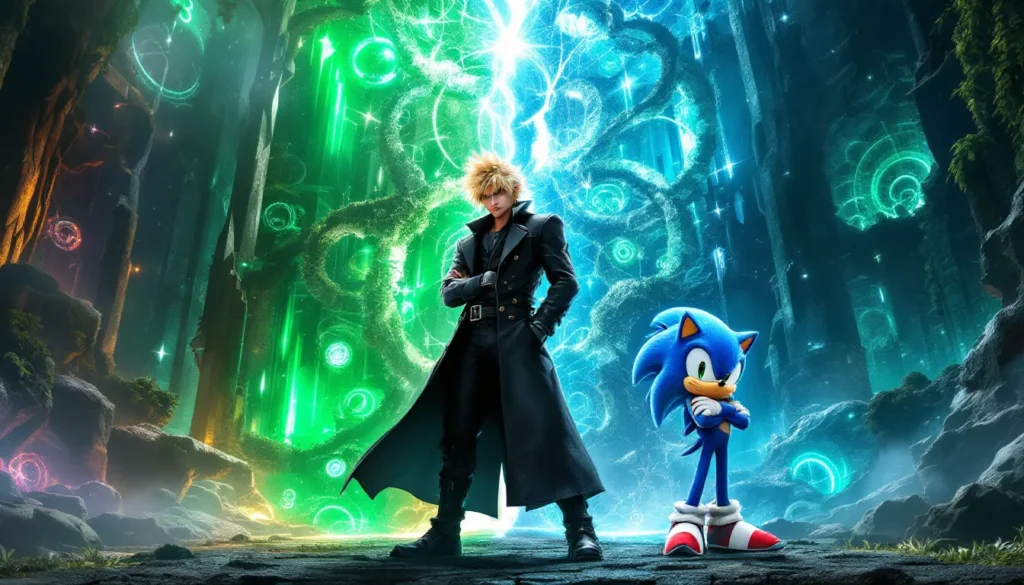
The game follows a newly discovered interdimensional rift that has pulled heroes from both realities into a single conflict. Rather than one franchise “invading” the other’s story, Final Fantasy Sonic X crafts a narrative where both sides must learn to cooperate against a mutual threat. The opening sets the tone perfectly: Cloud and Sonic meet as complete strangers in a fractured world, skeptical of each other’s methods but forced to work together.
What separates this from typical crossover fan service is the writing quality. Characters don’t just appear: they’re given genuine arcs that respect their original characterization while allowing them to grow beyond what fans have seen. Sonic’s impatience clashes with Cloud’s methodical nature in ways that feel earned through dialogue and gameplay. The developers clearly understand both franchises deeply, which shows in every interaction.
Key Features And Gameplay Mechanics
Combat System And Character Abilities
The combat system is perhaps the most critical element to understand before diving in. Final Fantasy Sonic X uses a hybrid action-turn-based system that shifts depending on your party composition and difficulty settings.
When you have Final Fantasy characters leading your party, the game emphasizes traditional turn-based combat with real-time ability execution. Cloud and Tifa act as the primary damage dealers with high DPS output, while characters like Aerith provide healing and support magic. But, the second you switch a Sonic character into the active slot, everything accelerates. Sonic, Shadow, and Knuckles can execute direct hits during enemy turns, creating momentum-based combos that reward aggressive play.
Ability activation works through a menu system combined with quick-time events. Instead of just selecting “Attack” and waiting, you’ll see action buttons appear that require precise timing. Missing a QTE (quick-time event) doesn’t fail you outright, it just reduces damage and breaks your combo chain. This keeps engagement high without punishing newcomers too harshly on lower difficulties.
Each character has a unique ability tree. Cloud builds materia (magic stones) that dramatically expand his spell library, while Sonic gains speed-based techniques that let him bypass environmental obstacles or chain hits together. The meta has already shifted dramatically since launch: early players relied heavy on Cloud’s Limit Break (ultimate ability), but patch 1.2 adjusted cooldown timers, making hybrid teams with balanced Sonic and Final Fantasy characters significantly more efficient.
Exploration And World Design
The Aetherspeed world is split into eight major regions, each heavily themed around locations from both franchises. You’ve got the Crystal Forest (Final Fantasy-inspired) directly adjacent to the Emerald Zones (classic Sonic topology). The design brilliance here is that neither aesthetic dominates, they blend naturally.
Exploration isn’t completely open-world, but it’s not linear either. Think Final Fantasy VII Remake level of guided exploration: you move through distinct zones that have multiple paths, secrets, and optional content. Sonic’s speed abilities let him access areas that other characters can’t, creating genuine reasons to return to previous zones with new party members. A chest that seemed inaccessible with Cloud might open up the moment you bring Sonic along for his ground-dash mobility.
Environmental puzzles require character diversity. Some need Final Fantasy’s elemental magic to activate ancient mechanisms: others require Sonic’s speed trials to trigger time-based platforms. This design choice forces you to experiment with different team compositions, preventing any single “optimal” setup from trivializing exploration.
Playable Characters And Their Roles
Final Fantasy Representatives
You’ll recruit four core Final Fantasy characters throughout the main campaign, with additional characters available in post-game content. The primary lineup includes:
Cloud Strife remains the physical DPS anchor, dealing high damage with sword techniques and materia combinations. His Limit Break, “One-Winged Angel,” still hits hard but requires setup time, not a panic button like some fans expected.
Tifa Lockhart functions as a close-range fighter with faster attack speed than Cloud but lower individual hit damage. Her strength lies in sustained damage and stagger mechanics (a system that breaks enemy poise). Stagger interactions have been central to the meta since launch.
Aerith provides essential healing and support magic, but the game doesn’t lock you into the classic “healer always supports” role. Her offensive spells are genuinely useful, and many high-level players run her as a hybrid damage-dealer on later difficulties.
Barret Wallace joins later in the story, acting as a tank with taunt mechanics and heavy AOE (area-of-effect) damage. He’s less popular than the core three in competitive speedrunning communities, but speedrunner Yuki_Plays posted a viral Final Fantasy 15 speedrun guide that breaks down why Barret shines in specific late-game scenarios.
Sonic Universe Heroes
The Sonic roster is where things get interesting. You get the obvious trio: Sonic, Tails, and Knuckles. But the game also includes Shadow the Hedgehog, Amy Rose, and Blaze the Cat as recruitable party members.
Sonic is your speed specialist and physical damage dealer. He hits faster than anyone else on the roster and can chain consecutive hits together. His drawback? Lower HP and defense mean you can’t facetank enemy damage.
Tails provides both mobility and ranged support. His twin tails allow him to hover over hazards and his two-handed blasters work as a ranged option. In AOE-heavy boss fights, Tails’ positioning flexibility makes him invaluable.
Knuckles functions as a bulky strength dealer with punch-based combos. He’s deceptively technical, his abilities reward timing and positioning, making him a favorite among high-skill players.
Shadow brings chaos emerald mechanics that power him up mid-battle. Managing his chaos meter adds complexity that feels rewarding rather than tedious once you master the timing.
The community still debates optimal team compositions, but consensus has formed around mixed groups: one strong Final Fantasy damage dealer, one Sonic speedster, one healer/support, and one tank or secondary damage dealer. This balance prevents either franchise from overshadowing the other mechanically.
Story, Plot, And Narrative Depth
Campaign Structure
The main campaign runs approximately 35-40 hours on normal difficulty, split across twelve chapters that gradually increase in scale and stakes. Each chapter introduces new mechanics, team members, or gameplay systems rather than just extending existing ones.
Chapters 1-3 focus on introduction and establishing why these two factions must work together. It’s slower paced but narratively critical, the writers spent time here because forcing characters together without earning it would’ve felt hollow. By chapter three, you’ve genuinely begun to understand why Sonic and Cloud’s different philosophies complement each other.
Chapters 4-9 are where the game reaches its stride. Plot reveals accelerate, boss encounters become memorable, and character relationships deepen. The writing here surpasses what many players expected from a crossover game. Tifa and Amy’s growing friendship, the rivalry between Shadow and Cloud, Sonic’s respect for Aerith’s strength, these relationships feel genuine rather than forced.
Chapters 10-12 serve as the climax, and without spoiling anything, the final three hours deliver emotional payoff alongside massive mechanical challenges. The ending respects both franchises’ tones while creating something uniquely its own.
Character Development And Story Arcs
Every recruitable character gets a personal story arc that resolves by game’s end. Cloud confronts his past identity in this world, he’s not “the” legendary Cloud of Midgar, but rather discovering who he is outside that definition. This arc mirrors his journey in the original game but approaches it from fresh angles.
Sonic grapples with being unable to simply “run away” from his problems. In his world, speed solves most conflicts. Here, he must sit with discomfort and work through complex emotional situations. It’s character development that the writers earned through narrative setup rather than it feeling like forced character assassination.
Tails becomes a voice of reason for Sonic, challenging him thoughtfully rather than just following his lead. Their dynamic shifts throughout the game, reflecting genuine growth.
Aerith’s arc is particularly compelling because it explores her role beyond mysticism. She’s treated as an intellectual equal to Cloud and the others, not relegated to “magic girl support.” By endgame, she’s driving plot decisions, not responding to them.
Even side characters like Barret and Knuckles receive narrative attention. Barret’s environmental concerns evolve as he sees the broader threats facing this merged world. The game respects its own cast enough to let them develop meaningfully. Recent coverage from Gematsu highlighted how the character writing exceeded typical crossover expectations.
Platform Availability And Technical Specifications
Supported Gaming Platforms
Final Fantasy Sonic X launched simultaneously across five platforms on March 15, 2026: PlayStation 5, **Xbox Series X
|
S**, PC (Steam and Epic Games Store), Nintendo Switch, and PlayStation 4.
The Switch version deserves special mention because it maintains feature parity while handling technical compromises elegantly. Character models remain detailed, though visual effects scale down. Load times are longer, expect 8-12 second transitions on Switch versus 2-3 seconds on current-gen consoles. This isn’t a “worse” version: it’s a different experience that plays identically even though visual variance. Players deeply invested in portable gaming have praised the Switch implementation extensively on community forums.
PC players received the full uncompromised experience. Steam released with DLSS 3 support, while Epic Games Store supports DirectX 12 upscaling. Ray-traced reflections, enhanced particle effects, and 4K resolution at 60 FPS are achievable on high-end systems. The game scales beautifully across hardware, mid-range GPUs run the game at 1440p/60 FPS without major compromises.
Performance And Graphics Quality
PS5 and Xbox Series X target 4K/60 FPS in “Quality Mode” or 1440p/120 FPS in “Performance Mode.” The developers nailed console optimization. Frame rate holds rock-solid throughout intense boss fights where visual chaos peaks.
Graphics quality sits somewhere between “current-gen showcase” and “thoughtful optimization.” It’s not chasing photorealism like some AAA titles: instead, it blends Final Fantasy’s stylized character designs with Sonic’s vibrant, cartoonish environments. This deliberate aesthetic choice prevents the two franchises from clashing visually. When Cloud stands next to Sonic, they look intentionally mismatched by design rather than appearing like one game’s assets inserted into another’s world.
Texture quality is crisp on all platforms. Environmental details are sparse where they need to be for readability, dense where they serve atmosphere. This restraint keeps performance stable even in zones with multiple simultaneous characters, particle effects, and environmental interactions.
The Metacritic score currently sits at 84, with technical performance praised consistently across professional reviews. Frame rate stability was one of the last major QA focuses during development, and it shows.
Tips And Strategies For Success
Early Game Progression And Character Building
The first six hours feel deceptively linear. You’re learning systems, meeting characters, and understanding the world. Don’t panic if you’re not optimizing, the game provides enough resources early on that you can’t seriously gimp yourself.
Once you reach chapter 3 and recruit your second character permanently, start considering your core team composition. You don’t need to lock in forever, but thinking about balance, DPS, healing, tanking, mobility, prevents frustration later. A team of four damage dealers sounds appealing but suffers badly against aggressive boss patterns.
Materia and ability progression works differently than traditional Final Fantasy games. Materia no longer gains AP through battle: instead, you allocate skill points earned from level-ups directly into trees. This flattens the progression curve slightly but rewards intentional character building. Don’t spread points everywhere: focus one or two abilities per character early on. You’ll have enough points by endgame to max everything, but early focus prevents dilution.
Weapon upgrading becomes available in chapter 2. Visit every vendor in new zones, they’re not always obviously marked on the map. Weapon tier matters more than you’d expect. Upgrading Cloud’s sword once per chapter prevents him from feeling like he’s doing half-damage compared to newer party members.
Difficulty settings matter. Normal difficulty teaches the systems well without punishing mistakes. Hard mode increases enemy aggression patterns, they combo harder and attack more frequently. Very Hard mode locks you out of some powerful items and requires genuine mastery of the mechanics. New players should start Normal, period. There’s no shame in adjusting later if you want more challenge.
Boss Battles And Advanced Tactics
Boss encounters are where the design philosophy becomes obvious. Every boss has specific patterns you can learn and counter. Some require specific characters to overcome mechanics efficiently, attempting a time-trial boss without Sonic available is possible but exhausting.
The most common mistake: brute-forcing damage without respecting boss patterns. Every significant boss has an obvious “punish window” after they complete attack sequences. This window lasts 3-5 seconds where you can hammer the attack button with minimal risk. Experienced players recognize these windows instantly: new players discover them by fighting bosses multiple times. The game respects player learning curves by allowing boss fights to be failed without severe penalties, encouraging experimentation.
Stagger mechanics are critical to high-level play. While attacking continuously damages bosses, building stagger through specific moves or consistent DPS interrupts their patterns and opens massive damage windows. A team focused on stagger buildup (Tifa, Knuckles, Sonic) will melt bosses faster than raw damage alone.
Limit Breaks are ultimate abilities with massive cooldowns. Don’t waste them on small encounters. Save them for boss phases where you need raw damage output or healing recovery. Intermediate players spam Limit Breaks constantly: advanced players hoard them for specific moments.
Healing needs thought, not just reactive mashing. Aerith has limited healing magic per battle. You need to decide: do you heal at 40% HP or push toward 20%? Running lower on health stretches resources further but increases failure risk. This decision-making separates adequate players from skilled ones.
The late-game boss fights (chapters 10-12) are genuinely difficult even on Normal mode if you’ve ignored character building. Don’t skip optional content, side quests, or equipment upgrades. They’re not busywork: they’re preparation for the fights ahead.
Recent competitive players have discovered that Final Fantasy VII strategies sometimes apply to Sonic X’s system. Advanced materia combinations that break the game in Final Fantasy VII work differently here due to balance adjustments, but theorycrafting carries over nicely. The community has already developed extensive boss guides, speedrun routes, and challenge-run strategies on Reddit and specialized Discord servers.
Community Reception And Critical Reviews
Final Fantasy Sonic X launched to strong critical reception and outstanding community enthusiasm. Professional review outlets scored it between 78-88 across platforms, with most criticism centering on specific late-game difficulty spikes rather than fundamental design issues.
The gaming community responded enthusiastically. Within the first week, streamers dedicated their channels to the game. Speedrunners immediately began exploring sequence-breaking routes, with the current any-percentage record standing at 8 hours 42 minutes, a full 30% faster than typical completionist runs. The community debate around “optimal” team compositions continues daily on Reddit’s r/FinalFantasySonicX subreddit.
One genuine criticism emerged: platform parity concerns. Some Switch players experienced longer load times that made exploration feel sluggish compared to console versions. But, patches have steadily improved performance. The latest update (patch 1.2.3) addressed specific loading scenarios that plagued handheld players.
Indie game analysis from Siliconera noted that the game succeeds precisely because it refuses to feel like a corporate product-placement exercise. The writing respects both franchises, the mechanics integrate thoughtfully, and the world feels purpose-built rather than retrofitted.
Support for the game has been exceptional. Square Enix and SEGA committed to post-launch content: new story chapters releasing quarterly throughout 2026, and new playable characters from deeper cuts of both franchises joining the roster in summer 2026. This roadmap maintains community engagement well beyond launch week.
The most telling indicator of success? Player retention remains strong weeks after launch, with active daily player counts still climbing. This isn’t a game people burn through and abandon: it’s one they’re legitimately enjoying and continuing to explore.
Conclusion
Final Fantasy Sonic X succeeds where most crossovers fail: it treats both franchises as complete equals and crafts a story that justifies their collision. You’re not playing a Final Fantasy game featuring Sonic as a bonus character, nor are you playing a Sonic game with Final Fantasy elements. You’re experiencing something genuinely new that borrows the best from both worlds.
The hybrid combat system rewards learning and experimentation. Character development is genuinely well-written. The world feels cohesive even though blending two radically different aesthetics. Platform availability means virtually any gamer can access it, and technical implementation respects each platform’s capabilities.
If you’ve been hesitant because crossovers often feel gimmicky, push past that assumption. Final Fantasy Sonic X is a legitimately strong JRPG that happens to star characters you already care about. Give it a shot on your platform of choice, whether that’s cutting-edge PC, current-gen console, or portable Switch. The adventure absolutely justifies the 35-40 hours it demands. And if you want recommendations for mastering the combat system or building optimal teams, the community is active, helpful, and always ready to discuss strategy.


